Mobulid rays
Giant manta ray (Mobula birostris)
The Giant manta ray (Mobula birostris) belongs to the family Mobulidae (mobulid rays) and is found in the Red Sea, with a wider Indo-Pacific range. It is a plankton feeder and usually seen in small groups. It reaches about 500 cm and is found at 1–50 m depth. IUCN conservation status: Endangered. It is not dangerous to divers.
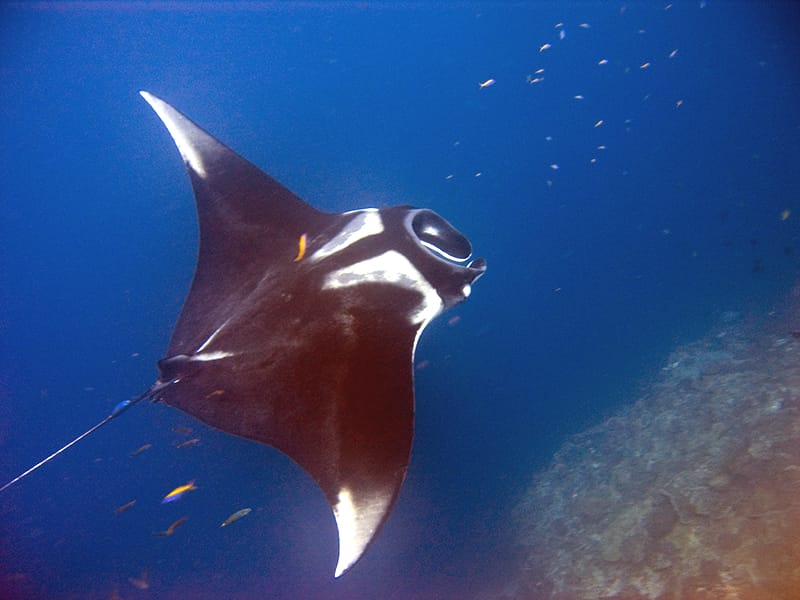
Quick facts
| Scientific name | Mobula birostris |
|---|---|
| Family | Mobulid rays (Mobulidae) |
| Common name (IT) | Manta gigante |
| Common name (EN) | Giant manta ray |
| Maximum size | 500 cm |
| Depth | 1–50 m |
| Distribution | Red Sea and Indo-Pacific |
| IUCN status | EN — Endangered |
Description
Present throughout the Red Sea, with a broader range across the tropical Indo-Pacific.
Where it lives
Present throughout the Red Sea, with a broader range across the tropical Indo-Pacific.
- Red Sea
- Indo-Pacific
Frequently asked questions
- What family does the Giant manta ray belong to?
- The Giant manta ray (Mobula birostris) belongs to the family Mobulidae (mobulid rays).
- Is the Giant manta ray dangerous?
- It is not dangerous to divers. As with any reef animal, do not touch or handle it.
- Is the Giant manta ray endemic to the Red Sea?
- No — it occurs in the Red Sea but its range extends across the Indo-Pacific.
- How big does the Giant manta ray get?
- It reaches a maximum length of about 500 cm.
Explore the Giant manta ray in 3D in the interactive atlas →