Puffers
Guineafowl puffer (Arothron meleagris)
The Guineafowl puffer (Arothron meleagris) belongs to the family Tetraodontidae (puffers) and is found in the Red Sea, with a wider Indo-Pacific range. It is an omnivore and usually seen alone. It reaches about 30 cm and is found at 1–50 m depth. IUCN conservation status: Least Concern. Treat it with caution (toxic if eaten): do not touch or handle it.
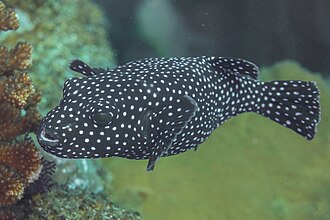
Quick facts
| Scientific name | Arothron meleagris |
|---|---|
| Family | Puffers (Tetraodontidae) |
| Common name (IT) | Pesce palla faraona |
| Common name (EN) | Guineafowl puffer |
| Maximum size | 30 cm |
| Depth | 1–50 m |
| Distribution | Red Sea and Indo-Pacific |
| IUCN status | LC — Least Concern |
| Hazard | Toxic if eaten |
Description
Present throughout the Red Sea, with a broader range across the tropical Indo-Pacific.
Diving hazard — Toxic if eaten: keep your distance, and never touch, corner or feed it.
Where it lives
Present throughout the Red Sea, with a broader range across the tropical Indo-Pacific.
- Red Sea
- Indo-Pacific
Diving safety
Toxic if eaten. This fish is toxic if eaten — its skin and organs can carry potent toxins. It is not dangerous to touch briefly, but must never be consumed.
If it happens
- Do not eat it. If someone has ingested it and shows tingling, weakness or breathing trouble, seek emergency care immediately.
After
- Any suspected poisoning needs a hospital: there is no home treatment.
Frequently asked questions
- What family does the Guineafowl puffer belong to?
- The Guineafowl puffer (Arothron meleagris) belongs to the family Tetraodontidae (puffers).
- Is the Guineafowl puffer dangerous?
- It needs caution: Toxic if eaten. Keep your distance and do not touch or handle it.
- Is the Guineafowl puffer endemic to the Red Sea?
- No — it occurs in the Red Sea but its range extends across the Indo-Pacific.
- How big does the Guineafowl puffer get?
- It reaches a maximum length of about 30 cm.
Explore the Guineafowl puffer in 3D in the interactive atlas →